Elevated Urban Rail Line 2A (Cat Linh – Yen Nghia): Infrastructure Transformation and the Urban Value Field
1. Project Overview and System State Shift (2021–2026)
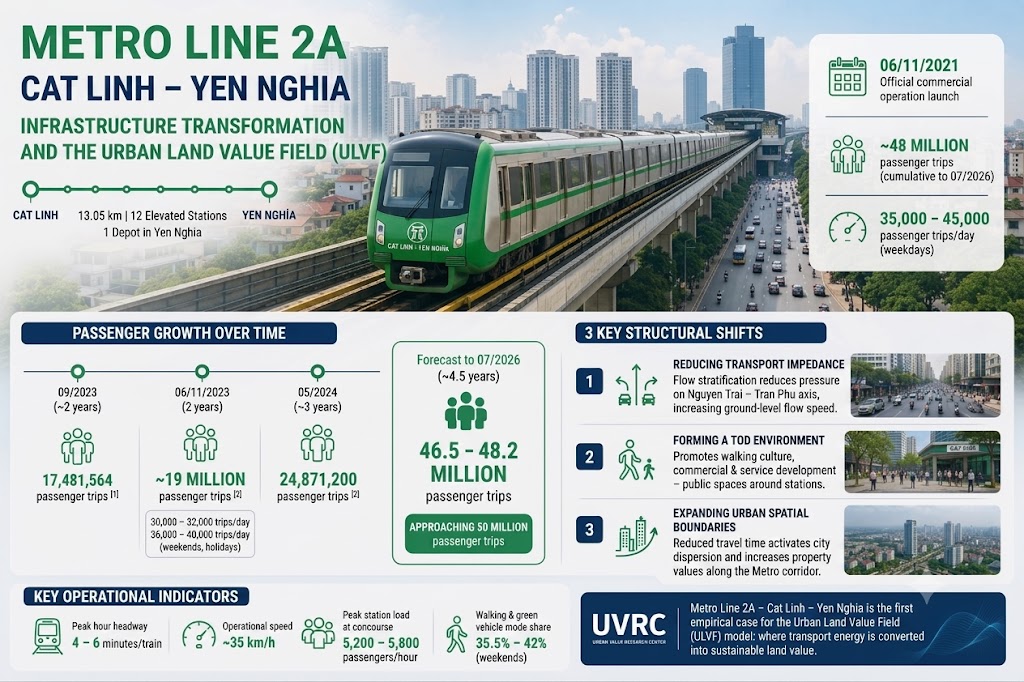
Urban Rail Line 2A (Cat Linh – Yen Nghia) is the first commercially operated metro line in Vietnam, as well as the first full-corridor realization of a Transit-Oriented Development (TOD) model in the country.
The line spans 13.05 km, featuring 12 elevated stations and one depot in Yen Nghia. Since its official commercial launch on November 6, 2021, Metro 2A has catalyzed a fundamental transition from a private-vehicle-dependent transport system to a multi-layered urban structure powered by mass public transit.
By July 2026, following nearly five years of continuous operation, the transit network has reached a steady state. According to Urban Value Field Economics (UVFE), this stage represents the "Network Saturation State"—where short-term infrastructure impacts have been fully absorbed into the spatial structure of the city and translated into long-term land value capture.
2021: System Activation → 2023: Traffic Flow Redistribution → 2026: Network Saturation & Value Field Convergence
2. Operational Scale and Ridership Growth
Official metrics indicate sustained growth in passenger volume across Metro Line 2A over the years.
- By the end of September 2023: 17,481,564 passenger trips [1].
- By November 6, 2023 (2nd anniversary of operation): nearly 19 million passenger trips, averaging 30,000–32,000 trips/day on weekdays and 36,000–40,000 trips/day on weekends [2].
- By the end of May 2024: 24,871,200 passenger trips [3].
Extrapolating from actual empirical growth trends, total cumulative ridership reached approximately 46.5–48.2 million trips by July 2026, nearing the landmark milestone of 50 million passenger trips.
3. Spatial Dynamics and Urban Structural Shifts
Metro 2A currently sustains a daily ridership volume of 35,000–45,000 passengers, operating at peak frequencies of 4–6 minutes and an operational speed of approximately 35 km/h.
The three-dimensional mobility space unlocked by the elevated metro line has substantially reduced transport impedance along the Nguyen Trai – Tran Phu – Ha Dong corridor, significantly improving accessibility between central Hanoi and its western districts.
Under the ULVF framework, this continuous surge in passenger flows signifies the conversion of kinetic transport energy into potential urban value, steadily accumulating within the Urban Land Value Field.
4. Three Core Structural Shifts
First, Metro 2A mitigates transport impedance and redistributes traffic flows, alleviating congestion pressure on the arterial surface network along the Nguyen Trai – Tran Phu corridor.
Second, the system is fostering a vibrant TOD micro-environment characterized by commercial expansion, service sector growth, and pedestrian-friendly urban realms around station nodes.
Third, drastic travel time savings between Ha Dong, Yen Nghia, and the central core have driven urban expansion and accelerated real estate value appreciation along the Metro corridor.
5. Implications for the ULVF Model
From the perspective of the Urban Value Research Center (UVRC), ridership metrics, travel time savings, and spatial accessibility are not merely operational transportation indicators—they serve as key observable variables reflecting the spatial redistribution of value energy across urban space.
As transit rider flows dynamically interact with the transport network and station nodes, spatial attractiveness reshapes the landscape, giving rise to shifts in the Urban Land Value Field (ULVF). This provides the empirical foundation for formulating forward and inverse problems within Urban Value Field Economics (UVFE).
References
[1] Hanoi Department of Transport (2023). Report No. 346/BC-SGTVT dated October 9, 2023, submitted to the Hanoi People's Committee on the management and operation of bus networks and urban rail lines.
[2] Hanoi Railway One Member Company Limited (Hanoi Metro) (2023). Press Release and Summary Report on 2 Years of Commercial Operation of Urban Rail Line 2A Cat Linh – Ha Dong.
[3] Hanoi Department of Transport & Hanoi Statistics Office (2024). Periodic Statistical Report Q2/2024 on Public Passenger Transport Volumes.